BiOLOVE's Chia-Wei Kao Wins the ASPIRE 2026 Young Investigator Award
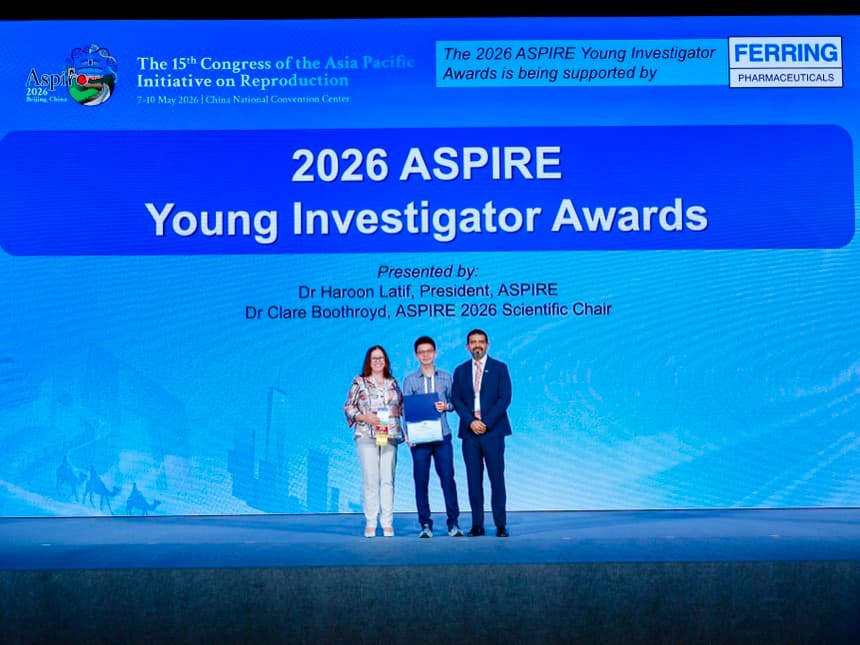
Chia-Wei Kao, Laboratory Manager and Data Analyst at BiOLOVE, has received the ASPIRE 2026 Young Investigator Award for research integrating blastocyst morphology and oocyte age to predict the probability of embryo euploidy. The work was presented in an English oral session at the 2026 ASPIRE congress in Beijing, demonstrating the team's combined capability across reproductive medicine, genetic testing and data science.
A euploidy prediction model built on 13,013 PGT-A records
In an IVF cycle, PGT-A assesses whether an embryo has a normal chromosome complement, but it requires an additional embryo biopsy. This study set out to predict the probability of chromosomal normality using non-invasive information already collected during treatment: oocyte age at retrieval, time to blastocyst formation, and the morphological grade of the blastocyst.
The team analysed 13,013 PGT-A embryo records to build the model, then externally validated it against 2,639 records from a second fertility centre. Oocyte age, the pace of blastocyst development and embryo morphology were all associated with the likelihood of euploidy. Combined into a single statistical model, they offer a reference for prioritising untested embryos and for clinical embryo selection.
Positioned as decision support, not a replacement for PGT-A
This is a prediction and risk-stratification model. Its value lies not in replacing PGT-A, but in turning the clinical and embryo data a fertility centre already accumulates into a decision-support tool with real practical potential. Completing cross-centre external validation adds materially to its credibility.
The aim of this research is not to replace PGT-A. It is to turn the oocyte age and embryo morphology data we already gather during treatment into a clinically interpretable tool, so that clinical teams can assess embryo priority more systematically.
Chia-Wei Kao, Laboratory Manager and Data Analyst, BiOLOVE
The recognition from ASPIRE also shows that the real-world data accumulated by Taiwan's reproductive medicine community carries genuine value for international research and clinical translation.
Taiwanese reproductive medicine research on the international stage
The award represents international recognition within Asia-Pacific reproductive medicine, and reflects BiOLOVE's cross-disciplinary strength across genetic testing, laboratory quality management, health information systems and data analysis. BiOLOVE will continue to deepen its data-driven research, turning long-accumulated clinical data into tools that improve workflow and support medical decisions.